Ipinapakita ang mga post na may etiketa na horror. Ipakita ang lahat ng mga post

Miyerkules, Oktubre 24, 2012

HORROR FROM THE MARGINS


SHAKE RATTLE AND ROLL 13 (2011)


Tamawo
Directed by Richard Somes
Written by Richard Somes, Aloy Adlawan, Jules Katanyag
Starring Maricar Reyes, Bugoy Carino, Zanjoe Marudo, Celia Rodriguez

Parola
Directed by Jerrold Tarog
Written by Jerrold Tarog, Aloy Adlawan, Maribel Ilag, Roselle Monteverde
Starring Kathryn Bernardo, Louise delos Reyes, Sam Concepcion, Ina Reymundo, Ara Mina, Lloyd Samartino

Rain Rain Go Away
Directed by Chris Martinez
Written by Marlon N. Rivera, Chris Martinez
Starring Eugene Domingo, Jay Manalo, Edgar Allan Guzman, Boots Anson-Roa, Perla Bautista


It is often argued that the spotlight of local mainstream cinema at the moment is no longer at the marginalized groups of society (the poor, indigenous people, militant groups, etc.) but at the privilege of the ruling class. It’s a saddening case then that the cries of real oppression are muted in favor of success stories via commercial achievements (the middle-class ideal for accomplishment) and the sugary narratives of boy-meets-girl. But for the genre known to make oppressive forces pay, local horror never neglected the marginalized. In fact, modern issues still have a special place in the heart of the grotesque. Such is the case here in SHAKE RATTLE AND ROLL 13, Regal’s annual horror treat for the Metro Manila Film Festival. (Still) chopped up to three narratives, this time it’s about a family who retreat to the idyll province (“Tamawo”), a revival of a dead friendship (“Parola”) and the horrors done by the 2009 storm Ondoy to rich factory owners (“Rain, Rain Go Away”). The film is no departure in terms of form. I’ve always thought that the cleancut digital quality of Regal’s visuals is anticlimactic compared to the earlier films’ mood and atmosphere. In fact, the content is quite familiar too. Since the MMFF is seen as an event offered for family bonding, the supposedly last installment of the horror franchise is all about families. But it’s not without its twisted reflections of contemporary social ills.

All episodes focus on the ideal family model: father and mother with their children try to cope with changes in their new situations. The family in “Tamawo” traveled from Manila to the stateside because the father finds the city chaotic, while the couple in “Rain, Rain Go Away” tries to cope up from the horrors of the nightmarish storm by building a new factory and retrying their chances at having a child. The bond of two families in the middle episode “Parola” would be disrupted by a secret affair. It is the disruption of the family’s peace that would let the horrors push through, but unlike “Parola”, the bookend episodes are haunted by the unrecognized marginalized groups of people. The tamawos are supernatural forces that stood in for indigenous people in the provinces. Years ago, their crystal has been stolen by a mortal who buried the treasure under a nipa hut. In the contemporary period, the tamawos threatens a family to bring out the treasure which the father actually discovered and hid. Only when the son offered himself as a sacrifice that the remaining members of the family achieve peace.

The third episode is direct in handling a much more recent issue regarding Metro Manila – floods. In “Rain, Rain Go Away”, a couple is haunted by ghosts of child laborers who drowned by Ondoy floods when they were locked-up in the old plastic ware factory owned by the rich couple. Thinking the horror has past, the rich couple found a new home and built a new factory (in a manner reminiscent of Imelda Marcos after the incident at the Manila Film Center). But the ghosts of the workers haunted the family and even took the lives of their relatives.

If this really is the last installment of the franchise then it managed to update audiences of recent circumstances occurring both in rural and urban sectors. A line from “Tamawo” has addressed the woes of indigenous people regarding the proceedings in mining (especially around Palawan). “Halos lahat ng bagay sa mundo ay nasa inyo na! ‘Eto na lang ang amin, papakialaman niyo pa!” said one of the tamawos in their conversation with the father. It is pitiful of course because what we thought of as a crystal was actually an egg that is carrying a premature embryo – the last member of the tamawos. The film has industrialization and modern society to blame for all the troubles done to the tribe. The relationship between the upper and the lower classes would be much more direct in the third episode. Child laborers were selfishly locked by the couple so they wouldn’t escape the job as makers of plastic containers. Plastic of course is known as the ultimate culprit to the flooding of the cities. That’s why plastic bans have started in different cities in the metro, though not all. The overproduction done by the capitalist couple in the film is the reason why the deaths and the eventual haunting occurred.

By putting our sympathies at the losses of the bourgeois family, it is easy to overlook the situation of the abject monsters/ghosts. These families sit pretty in their houses and when unfavorable incidents arouse (such as natural calamities), they selfishly save themselves and let the others die. But like the Ondoy victims in the third episode, the margins have their own way of returning. The film has bourgeois families (or people who can afford to watch Php150-200 worth of movie tickets) as target audiences and these audiences relate to the problems of the families they watch. But listen closely to the line said by the maid in the final episode “Makakalimutan natin ang lahat pero ang mga patay… hindi sila nakakalimot!”. We may stay at our comfort zones for long, but the ones from the margins will continue to haunt us until their voices are heard.

Sabado, Mayo 5, 2012

STAR CINEMA’S PERIOD HORROR STRUGGLES


Derek Ramsey is not a good actor. But he managed to be present in Star Cinema’s three latest movies that marked departures from its tiresome formulas: the first was One More Chance (2008) which showed the production giant’s care for feminist politics since Sana Maulit Muli (not to mention a more realistic approach in handling modern relationships); then there was the Temptation Island-wannabe No Other Woman (2011), a film that introduced adulterous sexual themes to their mainstream but new lows for anything in Philippine cinema; and lastly, this year’s much talked-about horror Corazon: Ang Unang Aswang (2012). Like One More ChanceCorazon’s fullpotential gets tangled up in the Star Cinema-ness of the production. But it is a departure nonetheless.
The plot was rather simple: Corazon (Erich Gonzales, in a convincingly campy performance), a barrio lass married to Daniel (Ramsey), lives in a post-war hacienda plagued by the Japanese soldiers, then a greedy landlord (Mark Gil) and finally a monstrously anguished female (guess who?). The root of the last one is Corazon’s own failure of delivering a son for Daniel. She becomes crazy and starts eating the children of their hacienda only to be chased away by the townsfolk. All is well.
Aesthetically, the film is a triumph in milieu. The setting perfectly captured my lola’s stories about the rurals fresh from the Japanese Occupation. But what I noticed prominently in the film is the clash between the styles of director Richard Somes (an indie favorite who made Yanggaw, also a horror film set in the province) and his Star Cinema collaborators that affected the rest of the film. For the example, Somes did surreal fast editing in scenes like Corazon’s demise. But it just looked awkward in the middle of teleserye-style technicals. This conflict affected the narrative too. Star Cinema’s love ideals always seem to interrupt the horror film’s plot. I thought it was abundant with romance cliches that it lacked subtlety as a horror film. Somes’ direction seemed upstaged by the dominant Star Cinema style. You can imagine the producers nagging at the director’s ear during both principal photography and post-production.
I guess Star Cinema was very hungry for a different kind of horror that they just squeezed the ideas of Richard Somes to help them conceive a turning point for the studio. Like last year’s Segunda Mano, the film proves (and even spells out before the credits) that a monster is not born but created. The “halimaw” image is all in the mind and Corazon, the “aswang” shows that the transformation of the woman to flesh-eating lunatic is due to her own anguish. This “anguish” is the result of many troublesome factors - perhaps it’s the villagers’ condemnation of her as a pre-slut, her inability to produce a child for Daniel (especially after performing tiring rituals), the atrocities experienced by the town during the war, or all of the above. But probably and most powerful of it all, it’s a woman’s revenge. Filipinos are well-aware of women’s condition during the war. They were raped, horribly tortured and their children were violently bayoneted in front of them. Her use of the boar as a costume for her nightly attacks calls to mind the historical significance of the animal during this period (Guerilla’s used the boar’s head to scare the Japanese away, while women use the boar’s blood to blot it on their underwear, thus avoiding rape).
One silenced subplot of the film is the growing antagonism of the landlord to the workers. Rarely would you find such class struggle in a Star Cinema film. But then, this struggle was put to bed when Corazon attacked. Their switch of antagonist is notable, too - if you can’t blame the greedy capitalist, why not target the crazy woman? Once again, Star Cinema’s feminist views seemed to be in question.
The final scenes seemed very symbolic enough: Daniel, after killing the landlord who burned his house and tried to kill his wife, gets back on the capitalist and gets chased away by his minions; Corazon, on the other hand, was chased by the male villagers because of her monstrosity. This symbolic couple (perhaps the proletarian and the anguished female?) left this plagued village to reach a destination all for themselves, and nobody ever heard from them ever again.
The horror genre is notable for its direct reflection of the turbulence of the period it depicts. Corazon: Ang Unang Aswang, for its departure from bourgeois culture and focus on post-war Philippines, is a rare horror film that at least tries to prove that in the local movie industry. Nice try, Star Cinema. - Gio Potes, May 2012

Huwebes, Mayo 3, 2012

THE RING AND POLTERGEIST: HORROR CINEMA’S DAMNATION OF MEDIA


What could be more horrifying than the realization that technology and media is taking over your life?

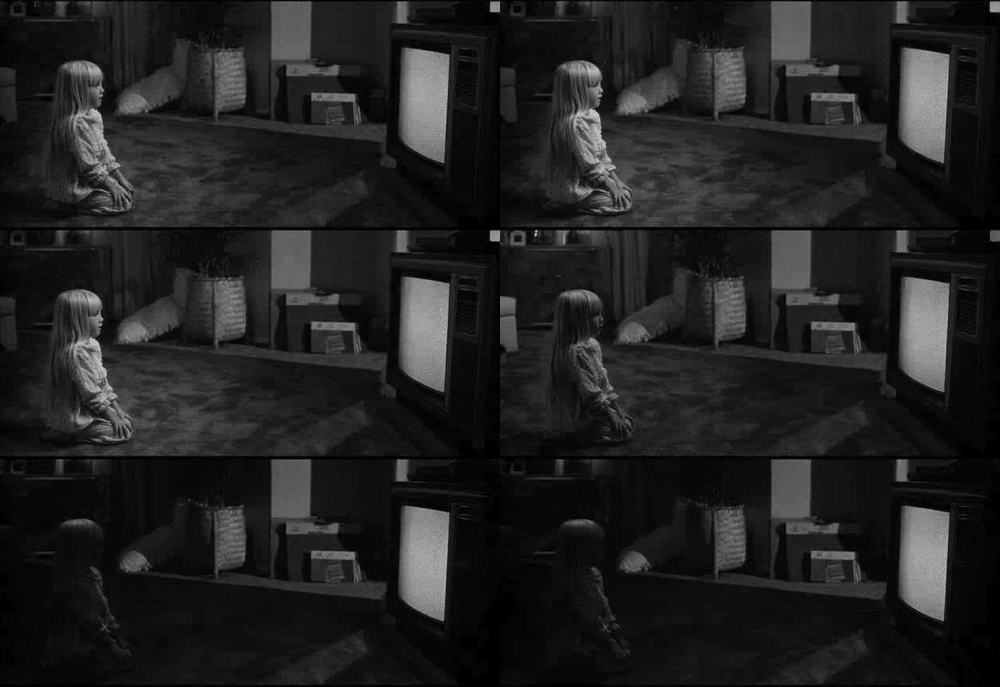
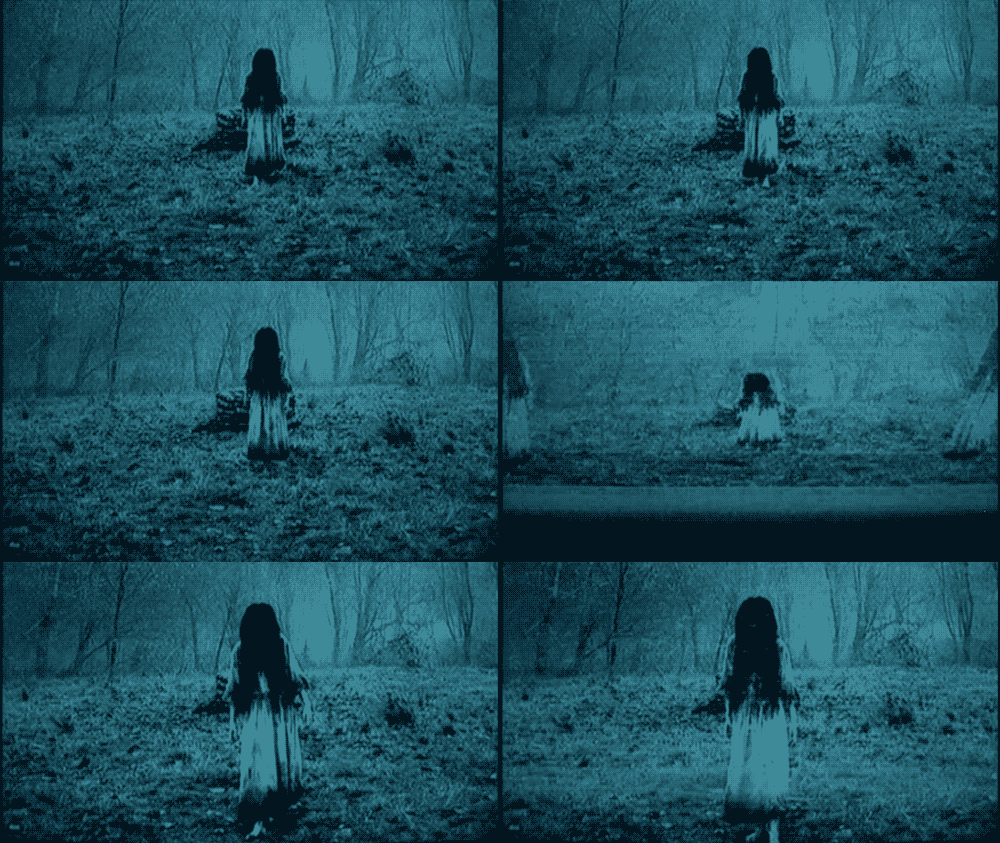
Tobe Hooper’s Poltergeist is about a family living in a haunted house. The heat actually starts when the youngest member of the family Carol Anne (Heather O’Rourke) gets abducted by these ghosts. How? Through the television of course! On the other hand, Gore Verbinski’s remake of the Japanese hit Ringu, The Ring, takes on a more surreal tone. Naomi Watts plays the role of a reporter whose niece (Amber Tamblyn) and her friends die of unknown causes, and rumors say they passed away because of a video tape. Her investigation leads to deeper trenches when she learns the source of this cursed tape.

On the surface, these films are classic examples of mainstream cinema’s success at horror. They’re remembered especially because of the iconic scenes they bear: Poltergeist’s child abduction and The Ring’s scene of a creepy little girl named Samara coming out of the television to kill the ones she curse. But a deeper understanding would show these films’ take on modernization and critique of television and media. It’s so much scarier to have this deeper understanding since the most influential medium (the television according to Time Magazine) is actually succeeding in sending its messages across to its audiences, even those messages that are hideous and inhuman. Like Carol Anne, their target is the youngest members of society because they know they would be naive enough to eat up their shit. And we, the passive boob tube audiences let ourselves be Carol Anne - abducted by these monsters that we become monsters ourselves… living and breathing under the influence of what is dictated, or what is popular even if it violates our own cultures. Everyday, we indulge ourselves into it and everyday, the horror is very present. Until when would we let these influence us? Would it reach the point where we die because of their own influences, because their very own Samara?

- Gio Potes, October 2011