Ipinapakita ang mga post na may etiketa na LGBT. Ipakita ang lahat ng mga post

Miyerkules, Oktubre 24, 2012

AFTERTHOUGHTS ON “Women and Gays in a Zombie-infested Paradise (review of ZOMBADINGS)”

The dynamism of film is forever a mystery to the avid viewer of cinema. What was once a well-beloved classic has been proven to be a mediocre and cheesy film from a period that is gravely important to document in the books. Such is my impression with Jade Castro’s ZOMBADINGS, a film that at first seems like a total hands-down moment for the local LGBT community made in a time when views on gender and sexuality have been shifting – until it proved to be not.


It all started when I heard from Jade Castro himself in a screening of the film. According to him, he was inspired by the film AN AMERICAN WEREWOLF IN LONDON (by John Landis, 1981) where a “man is being transformed into something he’s not”. Remington is indeed a young man “cursed” into homosexuality (from a mental illness, now a curse!) and only the power of a straight father who has not bed a single twink can save him. I get the picture, but when you realize he’s likening a live human being (a label gay activists have been fighting for decades to be treated as) to a monster is something else. Well I get it - monsters and gays are both considered “other” in a clean-cut patriarchal society. FRANKENSTEIN, Ricky Lee’s AMAPOLA... it’s all over popular culture. But do we really have to repeat that notion and translate it into a film that is very unsubtle yet also problematic about the whole gay issue?


Enter the case of camp. As he said so in interviews, Castro intended ZOMBADINGS to be camp. There was Roland Tolentino’s review of the film that questioned this. He says here

Hindi pwedeng magsimula ang isang proyekto na maging camp. Kailangan itong maging resulta o in hindsight na persepsyon. Hindi ako lalabas ng bahay bilang stereotipong parloristang bading dahil hindi ito magreresulta sa “dobleng camp.” Mananamit ako, at dahil labis ang pabalat na ukay-ukay o high fashion, halimbawa, maari akong maging camp.
Ang Zombadings ay mulat na camp, ito ay campy pero hindi camp. Ang nangyari sa pagpapatingkad ng proyektong maging camp ay negation ng camp. Walang irony o disjuncture sa dalawang pinagtatapat na mundo dahil naglapat ang pagpapatawa (intensyonalidad at resultang primaryo sa box-office) sa object ng pagpapatawa (ang kabadingan). (2011)

He ends the review by stating that ZOMBADINGS only reinforced stereotypes. Remington was a mere reinforcement of the “screaming faggot” stereotype that must be abolished in the straight man’s way. “Nag-kwento lang, at nag-reaffirm ng kwento”. It has pandered to a serious issue for some beef and ended up laughing at it.


From what I know, the best camp films didn’t initially intend themselves to be camp, because the label’s supposed to be what a film is avoiding – to become a joke. Yet the praise the previous camp films had influenced the Aughts in a way. It made a new generation of filmmakers go for the lessons of the past and imitate a trend, try to recreate an effect that would score an audience. Yes of course, it had its moments of pure gay eye and ear candy. Yet upon having all these bloated ideas exploding, the advocacy turned out to be lip service. You can ask the film itself – are you or aren’t you?


ZOMBADINGS is at times celebratory yet at times still brutally homophobic, and it ends up where it started – gays are still sissies looked at as a joke. It’s very problematic and unaware of what it stands for. The kid in the last scene says it all. He sees a golden gay walking on the street. The kid stops and points at him, telling his mom “Bakla, oh”. Just when you thought a negative remark would be blurted out, he immediately praises him with a face utterly forced to say “Ang gandaaa”. Would that be a sign of change? As Tolentino said, it is indeed still a big box of a film entrapping homosexuals into traits and keeping them there. The makers of ZOMBADINGS only made it taste so sweet. - Gio Potes, September 2012


Reference:

Tolentino, R. (2011). Mulat na camp at kawalan ng irony. Retrieved July 11, 2012 from http://pinoyweekly.org/new/2011/10/mulat-na-camp-at-kawalan-ng-irony/

Huwebes, Mayo 3, 2012

Women and Gays in a Zombie-infested Paradise.


What I love about Zombadings 1: Patayin sa Shokot si Remington is, of course, how it views Philippine homosexuality. But even though it's much more sugar-coated than, say, Pagdadalaga ni Maximo Oliveros or Ang Lihim ni Antonio and its political undertones are taken rather silently, it is among those rare movies today that acknowledges feminism as an essential part of LGBT. It's the year's perfect counterattack to the dreadfully anti-feminist barfbag No Other Woman (which curiously became the second top-grossing film in the country last year).


I smiled throughout this movie for its escapist nature. Set in a fictional Lucban, it is an unconventional fairy tale. The police officers make up of mostly trustworthy women. The gays are still the community fairies who design these ladies into Cinderellas. And the straight men are prominently lazy gents who populate the household, unless paid. Remington comes from the last group but a childhood curse turns him into a twink. And the resolution was a father-son sacrifice that would make a closet queen smile.


The film is escapist for members of the LGBT. It presents something far from the mainstream where mothers must stay home and the gays hide. But here, it's a happy place for gays and women. It may not draw closer to realism but the intentions of its filmmakers is noteworthy. They made Zombadings an allegorical film, turning the gay revolution into a mob of the undead ready to eat heterosexual flesh. Despite this, it seems only the young Remington and the gaydar-touting Daniel Fernando enjoy gay-bashing. The entire community of the fictional Lucban doesn't even see the gays as a threat. They acknowledge the abilities of the fairies from hair styling to housekeeping. In fact, if the women play the cops, the gays take over their responsibilities at home as housemaids. And then from normal, the gay community is even glorified. When Remington decides that he wants to remain gay, Lauren Young tells him he can't because the gays she know fight everyday for love and acceptance - something she believes he can't do. It might be too substantial but it's enough for a gay rights banter. If you think the film's gayness is fake then maybe that line alone will be the most honest. And I would eternally quote it. Don't leave the film during the credits for an even more elaborate message from Angelina Canapi.


Zombadings presents a fictional world where equality reigns and people are happy. Boy would I stay in such a world. But then again I realized - in time (perhaps not too distant from now) that Lucban will be real. - Gio Potes, May 2012.


Directed by Jade Castro. Written by Jade Castro, Raymond Lee & Michiko Yamamoto. Starring Martin Escudero, Lauren Young, Kerbie Zamora, Janice de Belen, John Regala, Angelina Canapi, Daniel Fernando, Roderick Paulate.


Full credits: http://www.imdb.com/title/tt1810861/fullcredits#writers


Biyernes, Marso 23, 2012

"VOGUE" 2012


Madonna
GIRL GONE WILD
M.D.N.A.


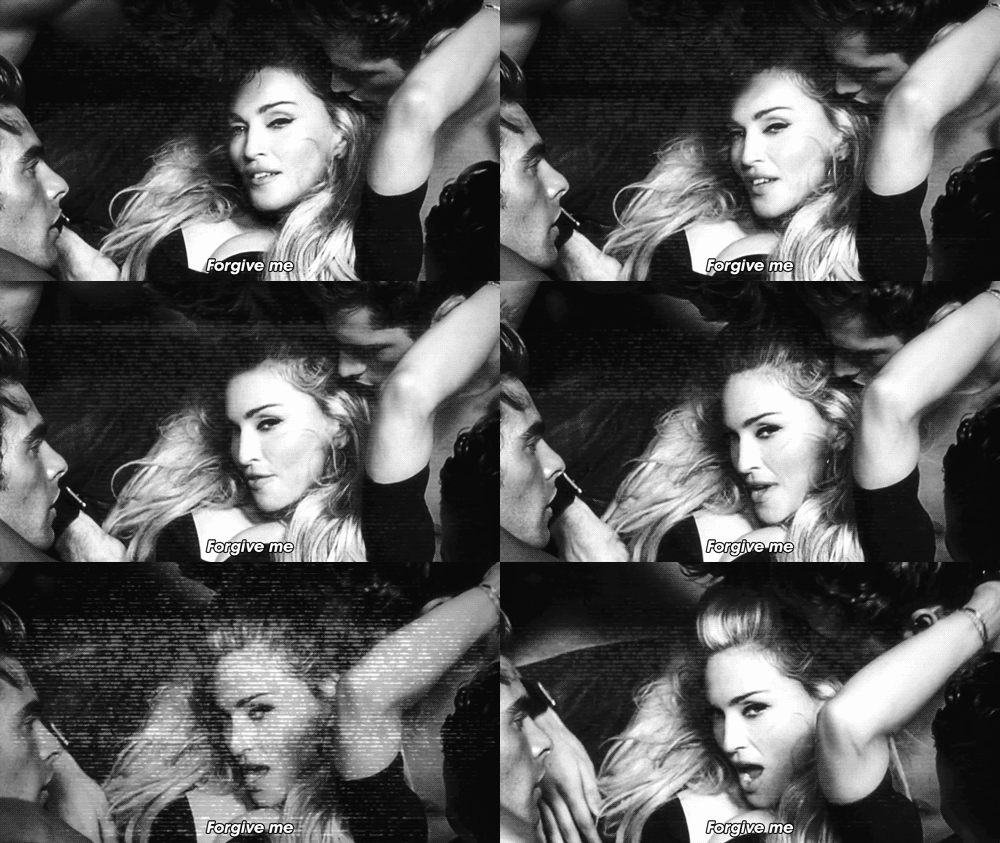
Madonna is finally acknowledging her own influence. The video for ‘Girl Gone Wild’ is a mash of different elements from her Imperial phase, given a fashion video (shall I cite Mugler as an influence?) style. Those elements at least did something new for Madonna, which means they were some new shit for women in music at the time. The video follows the vogue (no pun intended) of current pop video that is - ironically - also inspired by Madonna. But it’s fun and brings to the forefront of pop quite possibly another remarkable era for the “Queen of Pop”.

There’s no question about the style. It’s a lot better than the disastrous ‘Give Me All Your Luvin’. Like Lady Gaga’s (yes again, she must be mentioned!) video for ‘Alejandro’, the concept is simply centered around the female gaze. It’s more ‘Vogue’ than ‘Erotica’ with her as the Queen of Homosexuality all around, until she herself gets smitten by her subjects into a sexy sequel for ‘Truth or Dare’. The ‘Act of Contrition’ sample is quite tired, and is unfitting in a song about being ‘wild’. It doesn’t exactly mean being ‘bad’, right?

Remarkably she doesn’t look 53 at all, which is exactly the point - if the Imperial phase challenged feminism, this time Madge is challenging ageism. Not that I find the age disturbing, it’s just truly noteworthy how she remains so active after a handful of hits within - gasp! - three decades. And perhaps after being such a role model for young girls back in the ’80s, these girls are now her age and she reaches out to them through her own exercises encouraging how age doesn’t matter in corporate music. She looks as fun and as sexy as she was back in 1990. She continues to prove that she’s an unstoppable force. She managed to remain active in the industry holding her own power to whatever she wants to do with it. And that is simply amazing. Like what Robbie Williams said: Face it… she’s Madonna.

Yes, she might have moved forward with her fuck-you to ageism, but her fights for the LGBT remain in the 90s style as if she just flaunts her activism around as a part of the marketing package (something Lady Gaga gets accused of most of the time). Or yeah, maybe she’s just bored with all these fairies and decided to join them again for another round of ‘Who’s-Your-Queen?’ and the LGBT isn’t exactly her thing. Though I still hope that she would fight for the gays, since they’re the major reason why she’s up there.

Then after, maybe she can still own a place in pop culture’s throne(s).

Score: 4.5/5
Watch the video here: http://youtu.be/tYkwziTrv5o


Revisiting the Music of 2011


BORN THIS WAY by Lady Gaga

A week after the much-anticipated release of Lady Gaga's first single for 2011's much-anticipated album, Pitchfork's Tom Ewing wrote a blog about the whole emergence of pop music's self-empowerment hoopla:

""Born This Way" fits neatly into a current vogue for self-empowerment pop anthems with Pink's "Raise Your Glass" and Katy Perry's "Firework". The Village Voice's Rich Juzwiak has written pointedly about the "Great Gay Pander-Off Of 2010"; Pitchfork's Nitsuh Abebe has talked in New York magazine about how Gaga's rainbow fanbase-building is designed to "open up that circle of self-acceptance to anyone who wants in." And this is what makes the trend so interesting to me-- because these pop songs about self are becoming hits at a time when the presentation of self and the value of self is a bubbling issue across our culture. If Lady Gaga's trick is to make her fans believe their self-empowerment is socially important, she's picked a smart time to do it."

It was one of the most bloated events in pop culture. The self-proclaimed Mother Monster to her legion of Little Monsters gave a gigantic surprise to open the year. It was one that she promised way back September 2010, when she won Video of the Year for 'Bad Romance'. "I'm beautiful in my way coz God makes no mistakes/ I'm on the right track baby I was born this way!" goes the meat dress-donning gay rights activist. It was a fitting present to her admirers who bought in to her hype since the arrival of her renaissance that is 'Bad Romance'. That moment was the peak of her year, and her promise is one her fans held on to until the record finally arrived on February 2011.

A few months after the 2010 VMAs, the trend was all for the fairies. It was timely, that Gaga moment, for in the heightened Facebook Age of 2010 sprang the numerous cases of online bullying and teenage suicide mostly caused by homophobia. A popular case was the suicide of Tyler Clementi which placed LGBT groups in intense action. With these cases, pop music found a cause celebre: bullies. Ke$ha wrote 'We R Who We R' after learning these incidents. This was followed by the release of a series of pop songs including Katy Perry's 'Firework', and Pink's 'Raise Your Glass' and 'Fuckin' Perfect' all addressing the issue, like repackaged Christina Aguilera belters to save the lives of a troubled generation by saying that they're beautiful. Even the hit TV musical Glee was fearless in tackling the issue. The trend was not entirely new. Back in the 80s, when the height of AIDS was surfacing in the United States, artists like Whitney Houston, Madonna and George Michael released powerful songs about self. And in 2002, Christina Aguilera and Linda Perry wrote 'Beautiful' which left a trail of admirers who claim they were saved by such a song. You can watch 'Mean Girls' and see for yourself. Yet no other era underlined the issue more than in the years 2010 to 2011. With all these patriotism in 2010's pop music, it seemed the fight for gay rights has been pushed forward but not ultimately to its success. As of 2011, the only legalization accomplished was in New York City.

And so came February 11, the day of Little Monsters. Lady Gaga's labor of love has surfaced on her website. And you knew the hot air balloon of hype has exploded: 'Born This Way' was both a triumph and a disappointment.

Musically, Ms. Germanotta's first single for her sophomore album is an overproduced industrial disco anthem. It is brash and relentless, a no-holds-barred pop song. It spits its intentions straight to the face, and pounds down to the ear drums that it can be unbearable. Lyrically, it is a poem of patriotism. Perhaps it was the troubled youth Gaga is concerning within the center of her opus since most of Gaga's "Little Monsters" are teenage outcasts. That's what one would think at first but actually it addresses the totality of the human being, the whole of society. It's as if the impulsive superstar decided to finally be everything to everyone. Check the following list of social groups mentioned in the song and see if you're included: drag queens, subway kids, the youth, the insecure, the broke, the evergreen, the blacks, whites, beige, the Chola descent, the Lebanese, the Orient-made, the disabled, the outcast, the bullied, the teased, the gays, the straights, the bisexuals, the lesbians, the transgendered.

That's the size of ambition Lady Gaga injected within her song. No other gay anthem may be as big as this one yet no other artist would dare to do such mindblowing work, too. Not with statements like "Don't be a drag, just be a queen" or "No matter gay, straight or bi, lesbian, transgendered life/ I'm on the right track baby I was born to survive". Without a doubt, it's the highlight of Lady Gaga's young career so far, and it will be hard to top this one considering its hype alone.

In fact, it was forced upfront with so much hype and expectations that it didn't just land on top of the charts, it infuriated the community Gaga intended to embrace. Many gays found it too similar to Madonna's own 1989 self-empowerment anthem 'Express Yourself' also at the same time when she was beginning to have a gay following. The controversy heightened when she thanked Whitney Houston rather than Madonna in her speech at the Grammys. It is also possible that Gaga used the gay community for her own profit. After all, her fans are mostly homosexuals. Nevertheless, her song for them was ridiculed and mocked, giving the song such nicknames as 'Bored This Way', and the artist 'Lady FlopGa'. It's ironic to imagine all this hate towards a song written and recorded for love for equality and that love alone but, considering the juggernaut success she has achieved in just 3 years, it cannot be denied that these hateful speculations can be true.

In the end, Lady Gaga triumphed over all of them. Her song was a recordbreaking iTunes chart-topper and the most inescapable tune of the year, getting covered here and there, playing everywhere from clubs to the streets, achieving lots of recognition and saving the lives of countless teenagers. You can say that Elton John was right in describing the song as the new 'I Will Survive'. Flawed at best, Lady Gaga's promise is both the crowning moment and the explosion of the whole self trend. No other song will be as big and proud as 'Born This Way', and it came at the time when it was hugely necessary. - December, 2011